









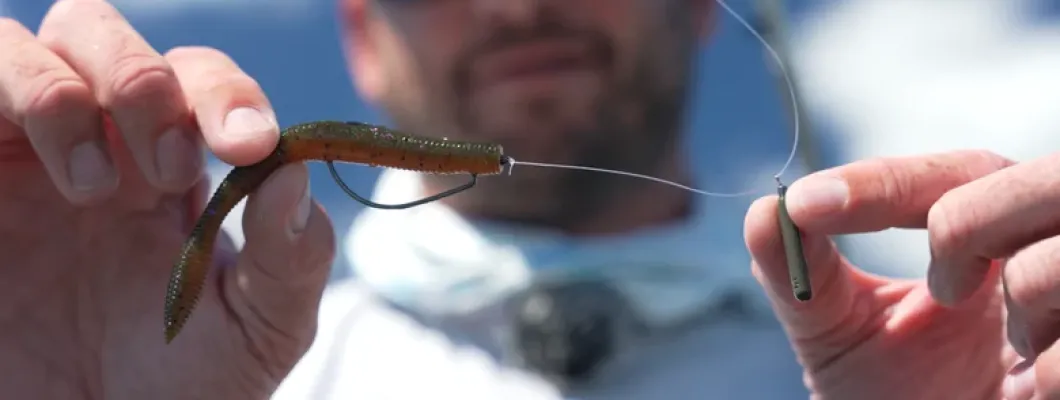
The free rig is still relatively underused by UK perch anglers, but it deserves far more attention. Most people associate it with a wide, flat creature bait slowly gliding behind the weight. That presentation is brilliant, especially when perch are feeding close to the bottom.
But the more time you spend with a free rig, the more you realise it is not limited to one style of lure or one type of venue.
Small creatures, craws, worms, soft jerkbaits and slim finesse shads can all work exceptionally well. You can fish it through weed, around timber, along canal shelves, beside moored boats or down a deep reservoir drop-off. It gives a soft plastic freedom that a standard weighted Texas rig cannot quite match.
What Is a Free Rig?
A free rig is simple: the weight runs freely on your line or leader above the hook, rather than being fixed to it.
When the rig falls, the weight reaches the bottom first while the lure continues to move and sink separately. That little gap creates a natural, unrestrained presentation. It is similar to the separation you get with a Carolina rig, but in a more compact, vertical format.
For perch, that is often enough to make a pressured fish commit.
Why the Free Rig Works So Well for Perch
Perch are curious fish, but they can also be cautious - especially on busy canals, clear gravel pits and heavily fished urban waters. A free rig gives them something slightly different.
The weight gets the lure down quickly, but the plastic is not pinned tightly to it. On the drop, it can flutter, glide or kick off to the side depending on the lure you choose.
A lot of bites come before the weight has even settled.
Often you will see the braid twitch, slowly move sideways or simply go slack earlier than it should. Do not wait for a big knock. Lift into the fish firmly and keep pressure on.
The Key Moment: When the Lure Meets the Weight
The initial fall is important, but do not switch off once the weight reaches bottom.
After a small hop or lift, the lure moves up separately from the weight. As it falls back down and touches the weight again, it can change direction sharply. With a craw or creature bait, this can look like a small crayfish dropping back into a defensive position.
That sudden change is a real trigger for perch.
Pro Tip
After each lift, watch your line as the lure falls back towards the weight. Many takes happen on that second fall, not when you first lift the rig.
Best Free Rig Lures for UK Perch
Traditional flat creature baits are still excellent, but do not limit yourself to them.
Creature Baits and Craws
Small craws and creature baits are my first choice around hard structure, weed edges and canals with plenty of bottom debris. They have enough resistance to glide nicely, while the claws and legs keep moving when the rig is resting.
They are especially useful where perch are feeding on crayfish, small invertebrates or anything living tight to the bottom.
Soft Jerkbaits
A 2.5–4 inch soft jerkbait is one of the most underrated free-rig options for perch. It has less resistance than a creature bait, so it drops quicker and more directly, but it still darts unpredictably as it separates from the weight.
This is a great choice for fishing along deep canal shelves, marina walls and reservoir drop-offs.
Worms and Stick Baits
Straight worms and slim stick baits are ideal when the water is clear or the perch are being difficult. They look subtle, but the free-moving weight gives them enough life to avoid looking static.
Fish them slowly around bridge supports, moored boats, lock areas and timber.
Finesse Shads
A small shad can work well when perch are clearly feeding on fry but are sitting close to the bottom. Instead of retrieving it steadily like a normal jig-head shad, let the free rig do the work.
Lift it, let it fall, pause, then repeat.
Where to Fish a Free Rig for Perch
The free rig is not just for open water. Its weedless hook setup makes it particularly useful in the sort of snaggy areas where bigger perch like to hold.
Try it around:
Canal boats, bridge supports and lock entrances
Reed lines and weed edges
Overhanging trees and fallen branches
Marina walls and pontoons
Deep reservoir shelves and drop-offs
River slack areas, creases and sheltered eddies
It is also a good option when you need to get through a small gap in the weed and present a lure right on the bottom.
Free Rig Setup for Perch
You do not need a heavy bass setup for UK perch. Keep it balanced and use the lightest weight that still allows you to maintain contact.
Rod and Reel
For most perch free-rig fishing, I would use:
A 7ft–7ft 6in light or medium-light spinning rod
A fast action for good bite detection and hook control
A 2000–2500 size spinning reel
A slightly longer rod helps when fishing deeper water or making longer casts across reservoirs. It also makes it easier to pick up slack line quickly after a perch takes the lure on the drop.
Line and Leader
Braid is ideal for this style of fishing because it makes subtle drop bites much easier to see and feel.
Main line: 0.06–0.10mm braid
Leader: 5–8lb fluorocarbon
Leader length: around 60–100cm
If there are pike present, use an appropriate wire or bite-proof leader. Do not rely on light fluorocarbon in waters where pike are likely to take your lure.
Weights
For most UK perch fishing, start with:
3.5g–5g for shallow canals and sheltered waters
5g–7g for deeper canals, rivers and light wind
7g–10g for deep reservoirs or stronger flow
A compact tungsten free-rig weight is worth using because it transmits bottom contact better and slips through cover more cleanly.
Hooks
Use a sharp offset hook matched properly to the lure.
Small finesse baits: size #2 to #1
2.5–3.5 inch lures: size 1/0
Larger creatures or soft jerkbaits: size 1/0 to 2/0
Rig the lure straight. Even a slight bend can make it spin or fall unnaturally.
How to Fish the Free Rig
The beauty of the free rig is that you do not need to overwork it.
Cast beyond the feature and allow the rig to fall on a controlled slack line.
Watch the line closely - the first drop is often the most important part.
Once it reaches bottom, give the rig a short lift or drag.
Pause and let the lure fall back separately to the weight.
Repeat slowly until you have covered the area.
In colder water, make smaller lifts and longer pauses. In summer or autumn, you can work it more actively with a couple of sharper hops before letting it fall again.
Pro Tip: Do Not Rush the First Drop
When you cast beside a boat, tree or weed edge, give the lure time to work. The weight may be on the bottom, but the lure can still be falling or gliding down behind it.
If the line moves sideways, stops too early or suddenly goes slack, strike.
Pro Tip: Change the Lure Before Changing the Rig
If perch are following but not committing, do not immediately abandon the free rig. Swap from a creature bait to a slim soft jerkbait or worm first.
The rig stays the same, but the fall and profile change completely. That can be enough to turn follows into bites.
When Should You Use a Free Rig Instead of a Texas Rig?
Both rigs are useful, but they do slightly different jobs.
A Texas rig keeps the weight close to the lure and is excellent for pitching into cover or working a bait with a direct, controlled action. A free rig gives the lure more freedom on the fall and after each lift.
Choose the free rig when:
You want a more natural falling action
Perch are taking on the drop
You are fishing a creature, craw or soft jerkbait
You need to get down quickly but still want a finesse presentation
You are fishing deep water or covering several depth changes
For a full breakdown of the traditional weedless setup, read our guide to Texas rig fishing for perch in UK waters.
Final Thoughts
The free rig is not just a niche technique for wide creature baits. It is one of the most adaptable soft-plastic rigs you can carry for UK perch fishing.
It gets your lure down quickly, fishes well around cover and gives perch a natural presentation that they often hold onto confidently. Start with a small craw or soft jerkbait, fish it slowly around structure, and pay close attention on every drop.
For more help choosing lures, gear, colours and rigs for different UK venues, read The Complete Guide to Perch Fishing with Lures in the UK.
Free Rig Fishing for Perch: Q&A
What is the best free-rig weight for perch?
A 3.5g–7g weight covers most canal, river and stillwater perch fishing in the UK. Go lighter in shallow, calm water and heavier when you need to reach deeper water or maintain contact in wind and flow.
Can I use a free rig in weedy water?
Yes. A free rig with an offset hook is very effective around weed edges, reeds, timber and other cover. Keep the hook point lightly buried in the plastic to make the lure more weedless.
What are the best free-rig lures for perch?
Small craws, creature baits, soft jerkbaits, worms and finesse shads all work well. Creature baits are a strong starting point, but a slim soft jerkbait can be excellent when perch are feeding on fry.
Do perch take a free rig on the drop?
Very often. Many bites happen as the lure separates from the weight and falls naturally towards the bottom. Watch your braid closely and strike if the line moves, stops early or goes slack unexpectedly.
Can I fish a free rig in deep water?
Yes. This is one of its biggest advantages. A slightly heavier weight gets the rig down quickly, while the lure still has freedom to move separately behind it. It is ideal for deep canal channels, marina basins and reservoir shelves.
Do I need braid for free-rig fishing?
Braid is not essential, but it makes a big difference. It improves feel, helps you spot subtle takes on the fall and gives better contact with the lure, especially at range or in deeper water.
Is a free rig better than a Texas rig for perch?
Neither is always better. A Texas rig is excellent for direct control in cover, while a free rig gives the lure more freedom and a more natural fall. Carry both and let the conditions decide.
